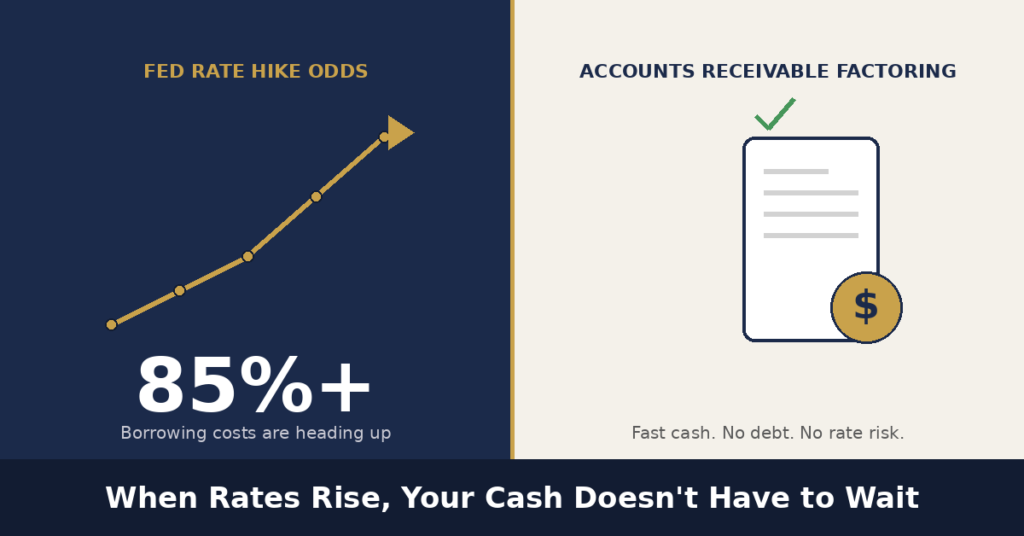
Quick answer: Market-implied odds of at least one Federal Reserve rate hike in 2026 have climbed above 85%, according to prediction markets and CME FedWatch data. That means the cost of traditional bank financing, lines of credit, term loans, and SBA loans, is likely heading higher, not lower. For B2B companies that need working capital now, accounts receivable (AR) factoring offers a way to unlock cash tied up in unpaid invoices without taking on new debt or exposure to rising interest rates.
What’s Happening with the Fed Right Now
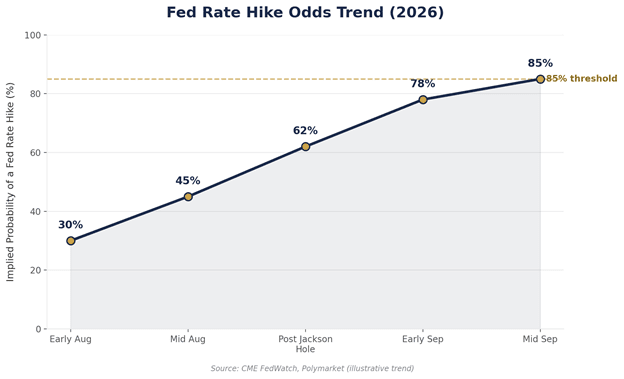
After holding rates steady through most of the year, the Federal Reserve’s tone shifted sharply following hawkish commentary from Fed leadership and hotter-than-expected inflation data. Odds of a rate increase at the Fed’s September meeting jumped from roughly 30% to nearly 80% in a matter of weeks, and the probability of at least one hike before year-end now sits above 85% on major prediction markets.
The drivers behind this shift include:
- Persistent inflation: August CPI data came in hotter than expected, with core inflation still running above the Fed’s 2% target.
- A resilient labor market: steady payroll numbers have given the Fed more room to prioritize inflation control over employment concerns.
- Hawkish Fed communication: recent public remarks from Fed leadership have signaled a renewed commitment to fighting inflation, even at the cost of higher rates.
- Supply-side pressure: ongoing energy and tariff-related cost pressures are adding to price stickiness.
For business owners, the headline number matters less than the practical outcome: borrowing is likely to get more expensive before it gets cheaper.
What a Rate Hike Means for Your Business’s Cost of Capital
When the Fed raises rates, the effects move quickly through the commercial lending market:
- Bank lines of credit get pricier. Most business lines of credit are tied to the prime rate, which moves in lockstep with the Fed funds rate. A hike translates almost immediately into a higher payment.
- New term loans carry higher fixed rates. Lenders price in expected future rate moves, so loan offers issued during a hiking cycle tend to lock in higher costs for years.
- Underwriting gets stricter. Banks typically tighten credit standards when rates rise, meaning approval can take longer and require stronger financials, a problem for growing companies that need capital fast.
- Variable-rate debt costs more immediately. Any existing floating-rate obligations reprice higher as soon as the Fed moves.
For B2B companies already managing tight margins, slow-paying customers, or seasonal cash flow gaps, this is exactly the environment where funding costs can quietly erode profitability.
Why Accounts Receivable Factoring Doesn’t Move with the Fed
Accounts receivable factoring works differently from a bank loan, and that difference matters most when rates are climbing.
With AR factoring, a business sells its outstanding invoices to a factoring company at a discount in exchange for immediate cash, often within 24 to 48 hours. Instead of borrowing against future revenue and paying interest over time, the company is simply accelerating cash it has already earned.
Because factoring is a purchase of an asset (the invoice), not a loan, it comes with several structural advantages during a rising-rate environment:
- No interest rate exposure. Factoring fees are typically based on invoice value and the creditworthiness of your customers, not the Fed funds rate.
- No new debt on the balance sheet. Factoring doesn’t add liabilities, which can matter for companies trying to preserve borrowing capacity or stay within existing loan covenants.
- Approval is based on your customers’ credit, not just yours. This makes factoring accessible to newer or fast-growing companies that might not qualify for a traditional bank loan.
- Funding scales with sales. As your invoice volume grows, so does your available funding — unlike a fixed credit line that may need renegotiation.
- Faster access to cash. Most bank loans take weeks; factoring can fund in days, which matters when payroll or supplier payments can’t wait.
Is AR Factoring Right for Your Business?
Accounts receivable factoring tends to be the strongest fit for B2B companies that:
- Sell on invoice terms (net 30, 60, or 90) to other businesses
- Have creditworthy customers but experience cash flow gaps waiting to get paid
- Are growing quickly and need funding that scales with sales
- Want to avoid taking on new debt during a period of rising rates
- May not yet qualify for traditional bank financing
Industries like staffing, trucking and transportation, manufacturing, distribution, and government contracting are especially well suited to factoring, since they commonly deal with extended payment terms and steady B2B invoice volume.
The Bottom Line
With Fed hike odds now above 85%, businesses that rely on variable-rate credit or plan to take out new loans should expect higher borrowing costs in the months ahead. Accounts receivable factoring offers a way to fund operations, cover payroll, and take on new business — without adding debt or betting on where interest rates go next.
Universal Funding works with B2B companies to turn outstanding invoices into working capital, fast. If rising rates are making traditional financing less attractive, now is a good time to see what factoring could look like for your business.
Frequently Asked Questions
Does accounts receivable factoring have an interest rate?
No. Factoring companies charge a discount fee based on the invoice amount and the paying customer’s creditworthiness, not an interest rate tied to the Fed funds rate. This means factoring costs generally don’t rise when the Fed hikes rates.
Is AR factoring the same as a loan?
No. Factoring is the sale of an accounts receivable asset (an unpaid invoice) at a discount, in exchange for immediate cash. It doesn’t create debt or a repayment obligation the way a bank loan does.
Will a Fed rate hike affect my existing business loan?
If you have a variable-rate loan or line of credit tied to the prime rate, yes — your payments will likely increase. Fixed-rate loans won’t change, but any new fixed-rate financing will likely be priced higher going forward.
How fast can a business get funded through factoring?
Most businesses can receive funding within 24 to 48 hours of submitting qualifying invoices, compared to the weeks it can take to close a traditional bank loan.
What types of businesses qualify for accounts receivable factoring?
Any B2B company that invoices other businesses on payment terms (such as net 30 or net 60) and has creditworthy customers can typically qualify, even companies without an extensive credit history.
Sources
- Fed Rate Hike in 2026? Trading Odds & Predictions — Polymarket
- September Fed Decision Is Now a Coin Flip as Rate Hike Odds Increase Post Warsh — CNBC
- Will the Fed Hike Rates in September? A 25-Basis-Point Move Is Now Expected — J.P. Morgan / Chase
- FOMC September 2026 Odds for a Rate Hike Surpass 50% — CME FedWatch data via Cryptonews
- Fed September 2026 Rate Hike Odds: Will Rates Rise 25 Bps? — CoinGape